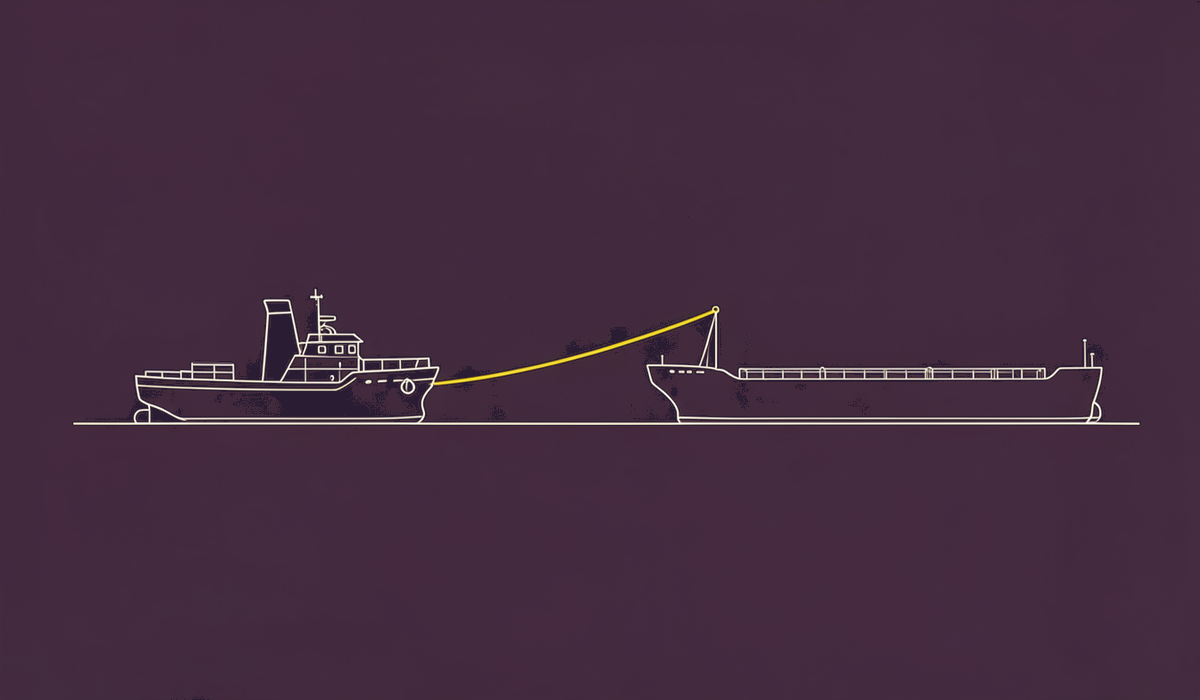
Salvage is the part of Turkish maritime law that pays a salvor for saving a vessel or her cargo. A salvor who brings a casualty to safety can be owed a reward by the owners of what was saved, backed, on the conditions the Code sets, by a maritime lien on the vessel and a right of retention over the other salvaged property. Where the casualty threatened the environment, the Turkish Commercial Code (TCC) adds special compensation, which is claimed when the reward falls short of the sum the Code calculates.
This guide sets out what counts as a salvage operation, when a reward is earned, how it is assessed, how special compensation works, who pays and how payment is secured, how salvage differs from general average, and the time limits. The rules are in the salvage chapter of the TCC, arts 1298 to 1319.
- Every salvage operation that has produced a useful result gives the right to claim a reward; unless the chapter provides otherwise, an operation without a useful result gives no right to the reward (TCC art. 1304(1)–(2)).
- The reward is fixed in money, and unless otherwise agreed it cannot be fixed as a percentage of the salved values; it cannot exceed the value of the salved property after the salvage (TCC arts 1304(3), 1305(3)).
- A salvor who worked on a vessel, or property in her, that threatened environmental damage, and has not earned a reward at least equal to the special compensation calculated under art. 1312, may claim its expenses from the owner as special compensation (TCC art. 1312(1)).
- The owners of the salved vessel and of the other salved property owe the reward in proportion to the salved values, and there is no joint liability among them (TCC art. 1306).
- For the salvage reward the salvor holds a maritime lien on the salved vessel, on the conditions of art. 1320(1), and a right of retention over the other salved property (TCC arts 1315(1), 1320(1)).
- All claims arising from a salvage operation are time-barred after two years from the end of the operation; the person against whom the claim is made may extend the period by declaration (TCC art. 1319).
What counts as a salvage operation?
The Code defines the operation by what is done and where. Any act or activity undertaken to save a watercraft or other property in danger in navigable waters is a salvage operation, and the salvage chapter applies to it (TCC art. 1298(1)). “Watercraft” covers every kind of ship and any structure capable of navigation. “Property” is anything not permanently and voluntarily fixed to the shore, together with a freight claim for which the right has not yet been acquired (TCC art. 1298(2)).
- kurtarma faaliyetisalvage operation — TCC art. 1298
- Any act or activity undertaken to save a watercraft or other property in danger in navigable waters.
The chapter also applies where the salvor was under a statutory duty to salvage, and where the salving craft belongs to the same owner as the craft salved (TCC art. 1299(1)). These exclusions limit the definition:
- fixed or floating platforms and offshore drilling units while they are used to explore for, extract or process mineral resources of the seabed, and prehistoric, archaeological or historic cultural objects on the seabed, are not “property” (TCC art. 1298(3));
- activities carried out despite the express and reasonable opposition of the owner or master of the craft, or of the owner of property that is not, and has not been, aboard (TCC art. 1298(4)(a));
- activities carried out by persons employed on the craft in danger (TCC art. 1298(4)(b));
- services rendered, or required to be rendered, to perform a contract made before the danger arose (TCC art. 1298(4)(c)).
The last of these exclusions makes the date of the contract important. Where a tug is engaged, the first fact to establish is whether the contract was made before the danger arose (TCC art. 1298(4)(c)); towage also appears as a separate head on the list of maritime claims (TCC art. 1352(1)(j)).
Salvage contracts and the duties of both sides
The master is authorised to make a salvage contract on behalf of the owner of the craft, and that authority includes agreeing on a court or on arbitration. The owner and the master are likewise authorised to make the contract on behalf of the owners of the property aboard (TCC art. 1300). The parties may change the provisions of the chapter by a salvage contract, expressly or by implication (TCC art. 1302(1)).
Two sets of rules cannot be changed by contract: the provisions on adapting or annulling a salvage contract, and the duty of care to prevent and limit environmental damage (TCC art. 1302(2)). On request, a court may adapt or annul a salvage contract in either of two cases: where it was concluded under the influence of misdirection or danger and the terms accepted are found contrary to equity and fair dealing, or where the reward is found grossly disproportionate to the services rendered (TCC art. 1301).
- The salvor owes the owner due care in the operation; care to prevent and limit environmental damage; a request for help from other salvors where that is a reasonable course; and acceptance of other salvors where the owner or master reasonably asks for them, the amount of the reward not being changed if the request proves unreasonable (TCC art. 1303(1)).
- The owner and master owe the salvor full cooperation during the operation; care to prevent and limit environmental damage; and taking delivery of the vessel or property once it has been placed in safety, when the salvor reasonably asks (TCC art. 1303(2)).
When does a salvor earn a reward?
The test is result. Every kind of salvage operation that has produced a useful result entitles the salvor to claim a reward (TCC art. 1304(1)). Unless the chapter provides otherwise, an operation that has produced no useful result gives no right to the reward (TCC art. 1304(2)). The reward cannot exceed the value of the salved property after the salvage; interest and the costs of proceedings are left out of account in applying that rule (TCC art. 1304(3)).
Every kind of salvage operation that has produced a useful result entitles the salvor to claim a reward.TCC art. 1304(1)
A salvor can lose some or all of the reward. A salvor whose own fault made the operation necessary or harder, or who acted fraudulently or in another way inconsistent with honest dealing, can be deprived of the reward in whole or in part (TCC art. 1311).
Saving life is dealt with separately. A person who is rescued owes no reward (TCC art. 1318(1)). A salvor who during the casualty saved only people is entitled to claim an appropriate share of the reward and special compensation awarded to the salvor who acted to save the vessel or other property or to prevent or limit environmental damage (TCC art. 1318(2)).
How the reward is assessed
If the parties have not fixed the reward, or a fixed reward is brought before the court to be adapted under art. 1301, the reward is set in a way that encourages salvage operations, having regard to the following criteria, which the Code lists without regard to order (TCC art. 1305(1)):
- the value of the vessel and the other property after salvage;
- the salvor’s effort and skill in preventing or limiting environmental damage;
- the degree of success achieved by the salvor;
- the nature and magnitude of the danger faced by the salved craft and the people and property in it, and of the danger run by those taking part in the salvage and their craft;
- the salvor’s effort and skill in saving the vessel, other property and human life;
- the time spent, the expenses incurred and the loss suffered by the salvor;
- the risk of liability the salvor took on, and the other risks run by the salvor and its equipment;
- how promptly the services were provided;
- whether craft and other equipment set aside for salvage were kept available for use and actually used;
- the readiness, efficiency and value of the salvor’s equipment.
Some sums are not part of the reward: the expenses and fees of public authorities, customs duties and other charges payable on the salved property, and the expenses of storing, protecting, valuing and selling it (TCC art. 1305(2)).
Special compensation for environmental damage
Special compensation is a separate claim. It is available where a salvor has carried out an operation for a vessel, or for property in her, that threatened environmental damage, but has not earned under art. 1305 a reward at least equal to the special compensation calculated under art. 1312. The salvor may then claim its expenses for the operation from the owner as special compensation. To award it, the court or arbitral tribunal does not have to raise the art. 1305 reward up to the highest value of the salved things (TCC art. 1312(1)).
- Expenses. The starting point is the salvor’s expenses: reasonable outlays made during the operation, plus an appropriate sum for the equipment and personnel actually used and reasonably to be used, fixed by the criteria of promptness, availability and use of equipment, and readiness, efficiency and value of equipment in art. 1305(1)(h), (i) and (j) (TCC art. 1312(3)).
- First increase. Where the salvor, by the operation, has prevented or limited environmental damage, the special compensation payable by the owner may be increased by up to thirty per cent of the salvor’s expenses (TCC art. 1312(2)).
- Further increase. The court or tribunal may increase it further if, having regard also to the criteria in art. 1305(1), it decides this is consistent with equity and fair dealing; the increase cannot in any case exceed one hundred per cent of the salvor’s expenses (TCC art. 1312(2)).
- Excess over the reward. The total special compensation calculated under art. 1312 is paid if, and to the extent that, it exceeds the reward the salvor could receive under art. 1305 (TCC art. 1312(4)).
- Negligence. A salvor who, through negligence, failed to prevent or limit environmental damage may be deprived of the special compensation in whole or in part (TCC art. 1312(5)).
- Outside general average. Payments under art. 1312 do not enter the general average apportionment, and the shipowner’s rights of recourse are not affected (TCC art. 1312(6)–(7)).
Who pays the salvor, and how payment is secured
The debtors of the reward are the owners of the salved vessel and of the other salved property at the moment the salvage operation is completed. The reward is shared among them in proportion to the salved values, and there is no joint liability among the debtors (TCC art. 1306).
A consignee who takes delivery of goods knowing that a reward is payable for them is personally liable to the salvage creditors to the extent that the reward would have been paid if the goods had not been delivered and had been realised (TCC art. 1307(1)). If other things were salved together with the delivered goods, the consignee’s liability cannot exceed the amount that would fall on the delivered goods if the costs were divided among all the things (TCC art. 1307(2)).
- Payment or security on delivery. When the salved things are taken delivery of, each debtor must pay its share of the salvor’s claims under the chapter or, at the salvor’s request, give security that also covers interest and the costs of proceedings (TCC art. 1314(1)).
- Lien and retention. For the salvage reward the salvor holds a maritime lien on the salved vessel and, on the other salved property, a right of retention under arts 950 to 953 of the Turkish Civil Code (TCC art. 1315(1)).
- Owner’s duty. The owner of the salved vessel must make every effort within its power to have the owners of the other property provide adequate security for their own debt, interest and costs (TCC art. 1315(2)).
- No removal. Without the salvor’s consent, the salved vessel and other property cannot be removed from the port or place first reached after the operation is completed until adequate security is given for the salvor’s claims (TCC art. 1315(3)).
- Advance. The court or arbitral tribunal competent to decide the salvor’s claims may, by an interim order, award an appropriate advance, which can be made conditional on security from the salvor; the security under art. 1314 is reduced by the same proportion (TCC art. 1316).
- Interest. Interest runs on the salvor’s claims under the chapter from the date the salved things should have been taken delivery of, or, for special compensation where the things cannot be delivered, from the date the operation concluded; other interest matters follow the general provisions (TCC art. 1313(1)).
Shares between salvors, owners and crews
A single reward is fixed for all salvage activity from the start of the danger until the return of the property is requested under art. 1303(2)(c); everyone who claims a share for taking part is paid out of that total (TCC art. 1308(1)). Where several actions are brought for a share, the Code provides for them to be consolidated, and the court seized decides in the same action how the reward is divided (TCC art. 1308(2)).
- Among salvors. The reward is divided according to participation in the operation, taking the art. 1305 criteria into account (TCC art. 1309).
- Salving ship. The owner deducts the loss and expenses caused by the salvage from the reward and gives the master and crew a share, having regard to the art. 1305(1) criteria. It prepares a schedule of shares as soon as the operation ends and notifies it to them in writing. They may object before the court at the first place in Türkiye reached, within fifteen days of arriving there, and the court’s decision is final (TCC art. 1310(1)–(4)).
- Craft that is not a ship. The reward is divided between the salvor and its people by contract, failing which by analogy using the art. 1305 criteria (TCC art. 1310(6)).
- Dedicated salvage ship or tug. Art. 1310(1)–(4) does not apply where the operation is carried out by a ship or tug dedicated to salvage, and its crew and other persons serving on it cannot claim a reward or share from the owners of the salved property either (TCC art. 1310(5)).
Salvage, the vessel and the lien
Salvage is a maritime claim. The list in art. 1352 includes a salvage operation or any salvage contract, and the special compensation payable for an operation concerning a ship, or cargo in a ship, that threatened environmental damage (TCC art. 1352(1)(c)).
The salvage reward also carries a maritime lien, provided the claim arose against the owner, lessee, manager or operator of the vessel (TCC art. 1320(1)(c)). It ranks ahead of all statutory and contractual pledges and real encumbrances on the vessel, registered or not (TCC art. 1323(1)), and ahead of all other pledges that arose on the vessel before the operation that gave rise to the claim. Where there are several salvage liens, the later ranks ahead of the earlier, each dated from the end of its operation (TCC art. 1324(2)).
The cost of removing a grounded or sunk vessel, where public bodies do so to protect navigation safety or the marine environment, is paid before all ship claims (TCC art. 1323(3)).
A claim that gives a maritime lien under art. 1320 is one of the grounds on which a vessel can be arrested (TCC art. 1369(1)(e)). Arts 1315(1) and 1320(1)(c) speak of the salvage reward (kurtarma ücreti); special compensation is a separate head in art. 1312. Ranking, enforcement and lapse are set out in our guide Maritime liens in Türkiye: which claims follow the ship, and the arrest procedure in How is a ship arrested in Türkiye, step by step?
Salvage or general average?
Salvage and general average both follow a casualty, and both can leave owners of ship and cargo paying. They are different claims under different rules, and the Code treats them in separate chapters. It also provides that payments of special compensation do not enter the general average apportionment (TCC art. 1312(7)).
| Question | Salvage (arts 1298–1319) | General average (arts 1272–1285) |
|---|---|---|
| What gives rise to the claim | An act or activity to save a watercraft or other property in danger in navigable waters (art. 1298(1)). | An intentional extraordinary sacrifice or extraordinary expense, reasonably made to protect the ship, cargo, other property and freight together from a danger that threatens them all (art. 1272(1)). |
| Who pays | The owners of the salved vessel and other property at the moment the operation is completed, in proportion to the salved values, without joint liability (art. 1306). | The shipowner at the time of the act, the freight creditor at the discharge date and the owner of the other property at the discharge date (art. 1274(1)). |
| Which rules apply | The criteria in art. 1305; the parties may vary the chapter by contract, except the rules in art. 1302(2). | Unless the parties agree otherwise, the most recent York-Antwerp Rules prepared by the International Maritime Committee and published in Turkish translation under art. 1273. |
| How the amount is fixed | By agreement, or by the court or arbitral tribunal on the criteria in art. 1305. | By an adjuster, whose adjustment the court approves on the application of any interested party (arts 1278, 1280–1284). |
| Security | Security on delivery at the salvor’s request (art. 1314); salved vessel and property not removed from the first port or place reached without the salvor’s consent until adequate security is given (art. 1315(3)). | Security must be given to the cargo interests for the ship’s share before the ship can leave the port where the loss is to be determined and apportioned (art. 1276); the master cannot deliver the goods until shares are paid or secured (art. 1277(1)). |
| Lien and rank | Maritime lien on the vessel; ranks ahead of all statutory and contractual pledges (arts 1315(1), 1320(1)(c), 1323(1)). | Maritime lien on the vessel; ranks after all statutory and contractual pledges (arts 1275, 1320(1)(f), 1323(2)). |
| Time limit | Two years from the end of the operation; extendable by declaration (art. 1319). | One year from the day the ship reaches the place named in art. 1279, the arrival place or, if the ship does not reach it, the port where the voyage ended (art. 1285). |
Time limits
All claims arising from a salvage operation, whether or not based on a contract, are time-barred after two years; the same article covers claims arising from wreck removal (TCC art. 1319(1)). For a salvage claim the period starts on the date the operation ends (TCC art. 1319(2)). The person against whom the claim is made may, by a declaration to the claimant made within the period, extend it once or several times (TCC art. 1319(3)).
- The claim. Two years from the end of the salvage operation, extendable by declaration (TCC art. 1319).
- The lien. One year from the date the claim arose, unless the vessel is arrested within that year and sold by forced sale as a result (TCC art. 1326(1)).
- The personal claim. Subject to special provisions in the Code and in other laws, the period in art. 1326 also applies to the creditor’s personal claims against the debtor (TCC art. 1327).
Each rule is stated in its own article, so check all three dates at the outset. The table of Turkish maritime time bars is in our guide Time bars in Turkish maritime law.
We advise and act for salvors and tug operators, owners, P&I correspondents and cargo interests who need to know whether an operation is salvage, who owes the reward and how it can be secured. The first questions are when the contract was made in relation to the danger, who owned each item of property when the operation was completed, whether the casualty threatened environmental damage, and where the vessel and cargo are now. See also our page on marine casualties.
Updates to this guide
14 October 2026
Guide published, against the text of TCC arts 1272–1285, 1298–1319, 1320, 1323, 1324, 1326, 1327, 1352, 1363 and 1369, and arts 950–953 of the Turkish Civil Code.
Questions readers ask
Does a salvor get paid if the operation does not succeed?
Every salvage operation that has produced a useful result gives the right to claim a reward; unless the chapter provides otherwise, an operation without a useful result gives no right to the reward (TCC art. 1304(1)–(2)). Special compensation under art. 1312 is a separate claim with its own conditions: the operation must have concerned a vessel, or property in her, that threatened environmental damage, and the salvor must not have earned a reward at least equal to the special compensation calculated under that article (TCC art. 1312(1)).
Is the salvage reward a percentage of the salved value?
The reward is fixed in money, and unless the parties agreed otherwise it cannot be fixed as a percentage of the values of the salved things (TCC art. 1305(3)). Whatever the method, the reward cannot exceed the value of the salved property after the salvage, leaving interest and the costs of proceedings out of account (TCC art. 1304(3)).
Who owes the reward: the shipowner or the cargo owner?
The debtors are the owners of the salved vessel and of the other salved property at the moment the operation is completed. The reward is shared among them in proportion to the salved values, and there is no joint liability among them (TCC art. 1306). A consignee who takes delivery of goods knowing that a reward is payable for them is personally liable to the extent that the reward would have been paid if the goods had not been delivered and had been realised (TCC art. 1307(1)).
How is special compensation calculated?
The starting point is the salvor’s expenses: reasonable outlays plus an appropriate sum for the equipment and personnel actually used and reasonably to be used (TCC art. 1312(3)). Where the salvor prevented or limited environmental damage, the compensation may be increased by up to thirty per cent of the expenses; the court or tribunal may increase it further if that is consistent with equity and fair dealing, but the increase cannot exceed one hundred per cent of the expenses (TCC art. 1312(2)). It is paid if, and to the extent that, it exceeds the reward under art. 1305 (TCC art. 1312(4)).
Can a vessel be arrested for a salvage claim?
Salvage is a maritime claim under art. 1352(1)(c), and the salvage reward carries a maritime lien if the claim arose against the owner, lessee, manager or operator of the vessel (TCC art. 1320(1)(c)). A claim that gives a maritime lien is one ground on which a vessel can be arrested (TCC art. 1369(1)(e)); the other grounds in art. 1369(1) turn on ownership, a lease of the vessel, security over the vessel, or a dispute about ownership or possession. The applicant must lodge security (TCC art. 1363(1)); check the figure in force at the time.
How long does a salvor have to bring a claim?
All claims arising from a salvage operation are time-barred after two years from the date the operation ends, and the person against whom the claim is made may extend the period by declaration (TCC art. 1319). The maritime lien lapses at the end of one year from the date the claim arose unless the vessel has been arrested within that year and sold by forced sale as a result (TCC art. 1326(1)). Art. 1327 applies the period in art. 1326 to the creditor’s personal claims, subject to special provisions in the Code and other laws.
Does a person rescued at sea owe a reward?
No. Persons who are rescued owe no reward (TCC art. 1318(1)). The Code gives a salvor who saved only people a claim to an appropriate share of what is awarded, as reward and special compensation, to the salvor who acted for the vessel, other property or the environment (TCC art. 1318(2)). Every master must assist any person in danger of being lost at sea without seriously endangering the vessel and the people aboard (TCC art. 1317(1)).